

In our deeply interconnected world, corporate and academic boundaries are no longer confined by geography. You might be launching a product from an office in New York to a team in Tokyo, or pitches could be streamed from London to stakeholders in São Paulo. It is no longer just about public speaking mechanics; it is about cross-cultural communication.
Speaking to a global audience without modifying your content often leads to a major disconnect—a phenomenon known as a talking to walls speech. This is where your words are heard, but your meaning, context, and impact are completely lost in translation.
To ensure your ideas hit the mark across borders, you must master the art of cross-cultural adaptation. This comprehensive guide outlines how to do a presentation that retains its depth and context, regardless of who is in the audience.
Step 1: Research and Understand Your Audience’s Culture
A successful cultural presentation begins long before you create your first slide.
Before deciding how to start a presentation, research your audience carefully:

- What kind of communication do they prefer?
- Is their cultural atmosphere formal or relaxed?
- How do they react to humor?
- What sensitive topics need to be avoided?
- Do they value detailed data or a concise summary?
Something you need to consider:
- High-Context vs. Low-Context Communication: Low-context cultures expect verbal messages to be explicit, direct, and literal. High-context cultures place less emphasis on the raw words and more on implicit cues, relationships, and reading between the lines.
- The Emotional Scale: Certain regions are comfortable with expressive, passionate displays of emotion. An energetic speaker who uses emphatic gestures may thrive in Italy or Brazil but could embarrass or distract an audience in Japan or the United Kingdom, where professional communication favors tight emotional restraint.
- Perception of Time: Punctuality and pacing expectations vary widely. While North American or Swiss audiences favor a fast, time-conscious progression, other business cultures prioritize relationship-building and detailed contextual background before diving into core metrics.
Actionable Tip: Prior to structuring your slides, research local corporate etiquette, taboos, and favored professional tones. Tailor your level of detail and presentation style to match what your target market considers respectful and authoritative.
Step 2: Build a Universally Clear Presentation Structure
A confusing presentation structure becomes even more difficult for international audiences to follow.
When audiences are processing content in a second language or through a different cultural lens, simplicity becomes essential.

1. The Hook: How to Start a Presentation
Knowing how to start a presentation is especially important for global audiences because first impressions establish trust.
Avoid:
- Local slang
- Region-specific jokes
- Culturally narrow references
Instead, begin with:
- Universal statistics
- Global trends
- Relatable business challenges
- Human-centered storytelling
For example:
- “Every day, over 5 billion people interact online.”
- “Communication challenges cost global businesses millions annually.”
These openings resonate across cultures more effectively than localized humor.
2. The Body: Keep Ideas Modular
A core principle of how to do a presentation globally is reducing cognitive overload.
Break your content into:
- Clear sections
- Short supporting points
- Simple transitions
- Digestible modules
International audiences process information more easily when:
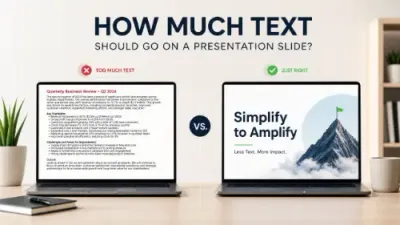
- Slides contain minimal text
- Concepts are repeated visually
- Key takeaways are reinforced consistently
3. The Conclusion: End with Absolute Clarity
Never assume your audience will infer your conclusion.
When learning how to give a great presentation, remember that international audiences benefit from explicit summaries.
Your conclusion should:
- Restate key insights clearly
- Reinforce action items
- Avoid ambiguity
- End with a memorable takeaway
Simple clarity outperforms complexity in cross-cultural communication.
Use Visuals to Reduce Language Barriers
Visual communication is universal.
Instead of text-heavy slides:
- Use charts and infographics
- Include diagrams and icons
- Simplify data visualization
- Highlight one key message per slide
This dramatically improves audience retention and engagement.
Step 3: Streamline Your Global Creation Workflow with Smallppt
Manually translating text, restructuring slide layouts, and re-tailoring graphics for multiple international regions is incredibly time-consuming. When you are balancing different cultural expectations, your design workflow should not hold you back.
To genuinely master how to give a good presentation globally without experiencing burnout, look to modern AI solutions like Smallppt.
Smallppt is an all-in-one AI PowerPoint generator and presentation productivity suite designed to take the friction out of content generation and localization. You can leverage Smallppt's native AI features to streamline your process:
- Multi-Language AI Engine: Simply input your core ideas, data points, outlines, or web links, and Smallppt will instantly generate highly structured, visually polished slide decks in your chosen target language.
- Context-Aware AI Writer: The built-in writing tool allows you to refine your wording, polish your phrasing, and adjust tones effortlessly. This ensures your message remains brief, clear, and culturally tailored without losing its foundational context.
- Professional, Global Layout Templates: Say goodbye to cluttered, text-heavy slides. Smallppt automatically applies clean, balanced, and professional layouts that match international corporate standards, letting you focus entirely on your delivery strategy.
Don't let manual slide design slow down your global expansion. Let Smallppt build your next cross-cultural slide deck in seconds, ensuring your messaging stays precise and professional across every border.
Step 4: Refine Your Delivery Style for Cross-Cultural Audiences
Once your structure is locked in and your slides are optimized, the final element of presenting successfully comes down to human execution. To ensure you know how to give a great presentation, follow these behavioral adjustments:

- Practice consciously: Don't just read the slides or recite the lecture notes. Stand up, practice loudly, and use conscious and controlled gestures. If you or your audience uses a non-native language, please speak slowly so that they have enough time to understand.
- Eliminate stuttering and rising intonation: avoid rising intonation at the end of a statement, which will make the statement sound like a hesitant question. Maintain a stable tone, so as to show authority and stability in different cultural backgrounds.
- Adjust the Q&A strategy: Be prepared to deal with the differences in audience interaction in the discussion session after the speech. In some corporate cultures that encourage confident expression, participants will ask questions directly.
FAQs
Q1: What is the biggest challenge in global presentations?
The biggest challenge is maintaining clarity while adapting to different communication styles, languages, and cultural expectations.
Q2: How can I improve my cultural presentation skills?
Research your audience, simplify your language, use universal visuals, and practice culturally aware communication techniques.
Q3: Why is presentation structure important for international audiences?
A clear presentation structure reduces confusion and helps audiences follow your ideas more easily, especially when language barriers exist.
Q4: How does Smallppt help with global presentations?
Smallppt uses AI to generate multilingual, visually consistent presentations quickly, helping users create professional international decks with less manual effort.
Conclusion
At its core, understanding how to give a good presentation to a global audience boils down to three pillars: audience empathy, explicit structuring, and the deployment of efficient technology.
By actively diagnosing your audience’s cultural expectations, stripping away local idioms, and utilizing automated design platforms like Smallppt, you can confidently step onto any stage. You will deliver your message clearly, protect your core context, and ensure your insights never turn into a talking-to-the-walls speech.